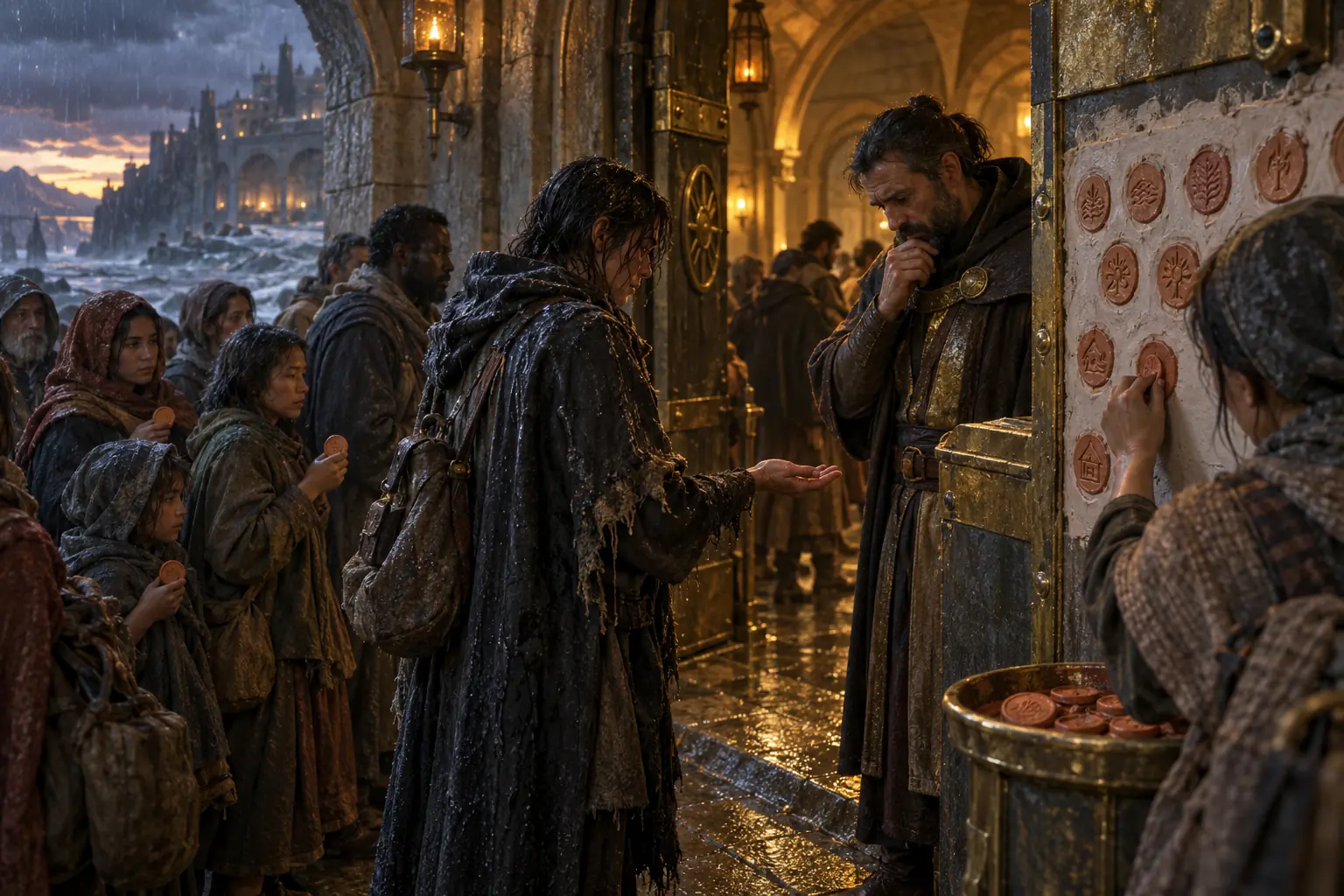
In the invented kingdom of Vey, two copies of a peace treaty sit on the same table. The original says the border prisoners will be exchanged after the harvest. The version delivered to the eastern guard says before. The translator changed one word because her brother was among the prisoners, and the guards opened a gate they had orders to keep shut. People died in the fighting that followed.
An official arrives with both documents, the translator's handwriting, and the names of those who died. He is the antagonist of the story. Nothing in his account is false.
His proposal is to close every translation school in the kingdom. Nobody, he says, should learn to put another nation's words into their own. A skill that can alter a treaty can alter the course of a war.
If the writer wants us to reject him, making his evidence disappear would be the easiest move. It would also throw away the interesting part of the conflict.
The facts can be right while the conclusion is wrong
The official has established something serious: a translation was deliberately falsified, the deception changed a military decision, and people were harmed. None of those facts tells us that every translator is dangerous, that ignorance makes agreements safer, or that a school should be closed.
He has smuggled a judgment into a chain of evidence. The step between 'this happened' and 'therefore we must do that' is where his character lives. One act becomes a verdict on a profession. An individual failure becomes permission to remove a public good.
A useful antagonist does not need to lie about what happened. He needs a plausible reason to choose the punishment he chooses. Perhaps he fears a second forged treaty more than he fears a kingdom unable to understand its neighbors. That fear may be sincere. Its sincerity does not justify his remedy.
Notice what this does to the protagonist. She cannot end the scene by pointing out an incorrect date. She must argue about responsibility, risk and the people her opponent's remedy would harm.
Let the protagonist lose an argument they deserve to lose
The translator did alter the document. If the story quietly reveals that she was innocent all along, the question of what she owes the dead is removed before she has to face it. A last-minute conspiracy can be thrilling in another kind of tale. Here it would excuse the very choice that made the scene difficult.
Instead, make her answer the question she hopes nobody will ask. Did she know the revised sentence might put the guards in danger? Had she tried another way to rescue her brother? Was there a moment when she could have corrected the record?
Her answers may make us less comfortable with her. That is not a defect. The reader can oppose the official's sweeping ban without being required to approve of what the translator did.
One way to test an argument in a scene is to give its strongest true point to the person we least want to win. If our preferred character can reply only by changing the subject, the story has discovered a weakness worth keeping.
A convincing antagonist pays attention to something real
The official need not be a secret monster who enjoys burning schoolbooks. He may have spent years working through treaties that were mistranslated carelessly, sometimes with terrible consequences. He may have taught an apprentice who trusted the forged sentence. He can recognize the power of language better than anyone in the room.
That experience explains his vigilance. It does not absolve his decision to destroy a discipline rather than make its practice more accountable.
Give him an offer that costs the protagonist something. He will spare her prosecution, perhaps, if she publicly supports the closure. That bargain forces a choice between her own safety and the future of people who had no part in her crime. His evidence becomes pressure, not decoration.
He should also be allowed to resist easy persuasion. A speech about the beauty of languages would not answer the dead guards' families. If the translator wants another solution, she must describe how altered documents will be detected, who can challenge them and who bears responsibility when safeguards fail.
These are unromantic questions. They give moral conviction a shape that another person can examine.
Do not let the ending erase the record
The most convenient ending would deliver both justice and comfort. The official withdraws his proposal, the translator is forgiven, and the kingdom applauds a renewed commitment to understanding. But the original treaty remains on the table. So do the names of those who died.
A more durable ending might have the translator testify publicly, lose her position and help establish a practice of independent translation. The schools remain open, but nothing restores her brother's trust or the lives lost at the gate. The official may vote against the new safeguards because he believes they are insufficient.
The choice need not satisfy every character. It should show that the story has not forgotten the facts it asked us to take seriously.
The question beneath the argument
When revising an antagonist, write down the claim they can prove and the action they want that claim to authorize. Put them in separate sentences. Then ask whether the action actually follows, or whether a fear, value or appetite for control has filled the gap.
Do the same for the protagonist. What would they have to admit before their opposition became credible? What price would their proposed alternative impose on someone else?
A villain who is wrong about everything offers the pleasure of correction. A villain who is right about something important demands a harder act from the hero: to face the truth without surrendering the right to decide what should be done with it.
Part of Beyond the Known, an independent journal by Arin Vale.
Read our editorial approach