Fictional rules are often explained while they work: the bell rings, everyone bows, and the day continues. The reader receives information, but the custom remains scenery. Put one person at the threshold who cannot comply, and the same rule becomes a source of pressure.
The exception should not exist merely to trigger a lecture. It should change what somebody can do next.
Begin at the threshold
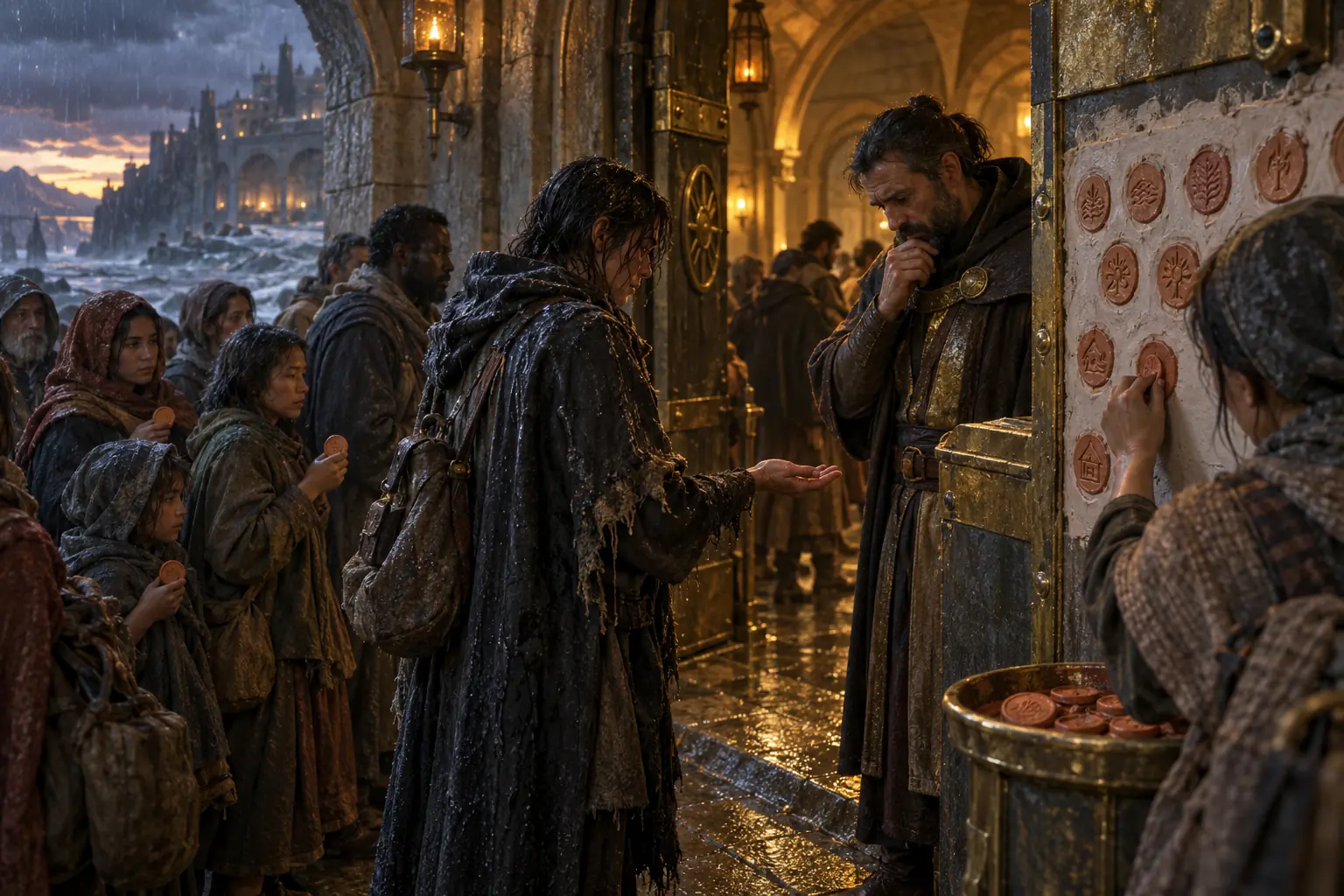
In the fictional city of Orra, every household owns a fired-clay seal. When flood sirens sound, one resident presses that seal into wet plaster at the shelter gate. The mark reserves spaces for the household and tells relief clerks which streets have arrived.
Now Nera reaches the gate with an empty hand. Her building has collapsed into the river, taking the seal with it. The keeper asks for her mark. Nera opens her palm and says, “The river has mine.” Behind her, the second siren begins.
Within a few lines, the reader sees the shelter, the household system, the threat, and the authority at the door. The rule matters because it blocks a person with an urgent goal.
Give the rule a good reason
If the keeper is simply cruel and the rule is obviously foolish, the scene becomes easy to judge. A stronger version lets the custom solve a real problem. Perhaps the seals were introduced after an earlier evacuation in which duplicate claims filled shelters while several streets received no places at all.
The keeper can fear that admitting an unmarked household means another family will arrive to find the shelter full. Nera can point out that the system assumes a home will survive long enough to prove its residents belong. Neither concern has to be invented solely to win the argument.
A reasonable rule with a painful exception reveals more than an absurd law. It shows what the society prepared for—and what it failed to imagine.
Let the response define the world
The keeper could refuse Nera, wave her through, ask a neighbor to share a seal, or create a temporary mark that must be investigated later. Each choice describes a different institution. Even a compassionate workaround can create a cost, such as a delayed entry, a disputed ration count, or an obligation to the person who vouched for her.
Keep Nera larger than the problem she exposes. Let her know something useful about the river, reject a humiliating bargain, or propose a solution the keeper has not considered. She is a character making choices, not a tool for displaying the setting.
Try it in a draft
Choose one custom that feels ordinary to most people in your invented world. Then ask four questions: Who cannot obey it? Why can they not simply choose otherwise? Who has the authority to bend it? What becomes harder if they do?
Write the collision in about 150 words before explaining the custom's history. Keep only the background the characters need in order to act. A broken rule does not merely describe a world. It shows what that world protects when its system meets a person it failed to imagine.
This essay uses an invented scenario to explore an idea. It is not a claim that the imagined technology exists, and it does not establish canon for Arin Vale’s forthcoming novel.
Part of Beyond the Known, an independent journal by Arin Vale.
Related reading: Build a world through breakfast
Read our editorial approach