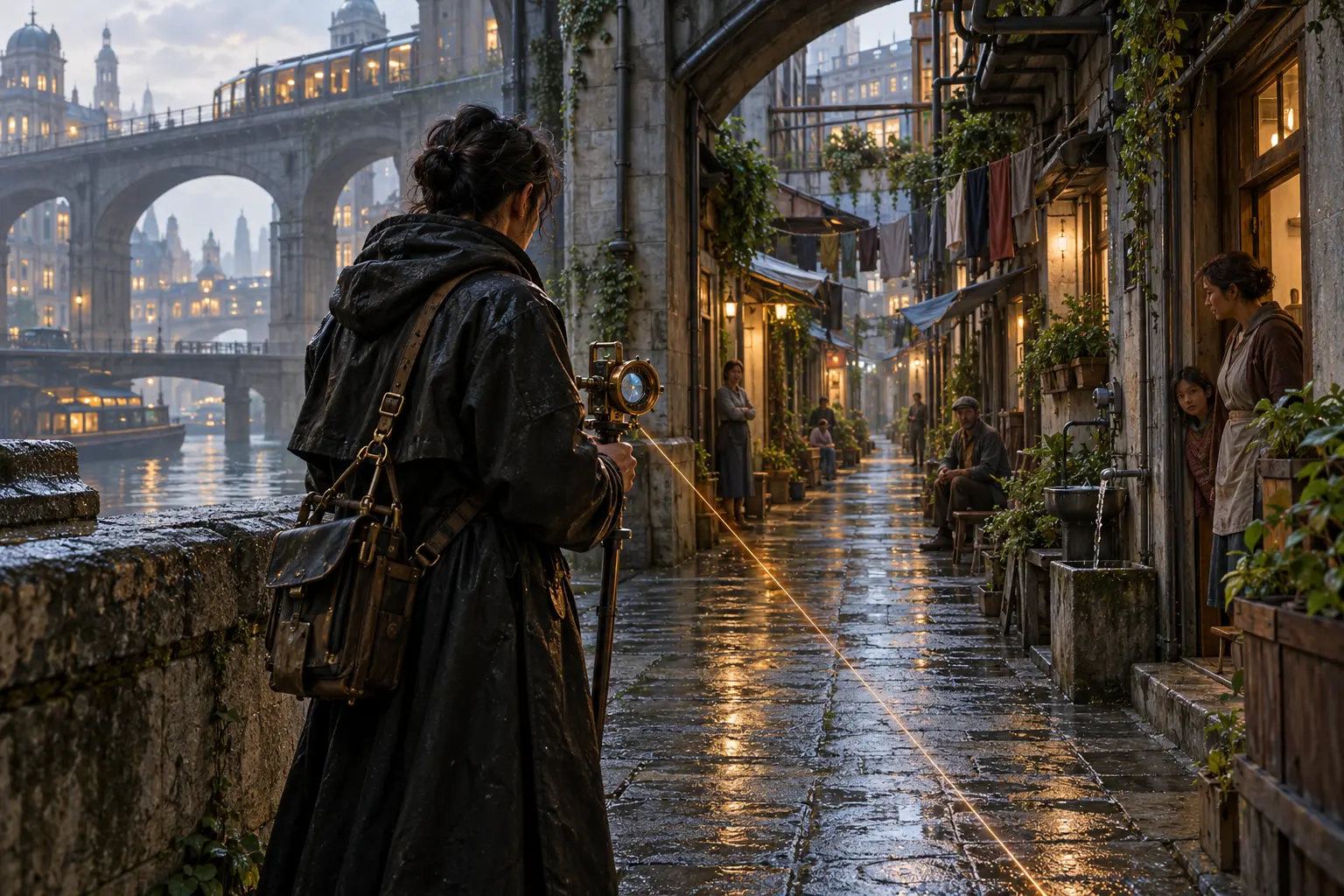
The street appeared on Rhea Tal’s instrument before it appeared to her eyes.
Her survey lens showed a copper line running through the west floodwall, forty-three metres long and branching twice. The official atlas showed only stone. Rhea recalibrated against the canal markers, then walked the wall until she found a door painted the same grey as the masonry.
It opened before she knocked.
Beyond it, a narrow lane ran beneath the transit arches. Nineteen doors faced one another across rain-dark paving. Laundry hung from steam pipes. Someone had fitted a brass basin beneath a leaking municipal tap, and three children were floating folded paper boats in it.
An old man stepped between Rhea and the lane. His coat bore the faint rectangular patches left by removed address tiles.
“You took your time,” he said.
“This place isn’t in the atlas.”
“That was the arrangement.”
His name was Tav Orso. He had painted shop signs in the river quarter until the city raised the new embankment and condemned his building. The other residents had similar histories: a kitchen porter whose room became a pump station, two sisters displaced by a tram depot, families who had been offered temporary housing in districts where temporary had expired years ago.
They called the lane Lantern Cut. It had a bakery window, a repair bench and a rota for clearing the drains. It also occupied a service passage belonging to the Flood Authority.
Rhea lowered her instrument. “If I record it, the atlas will notify Land Registry.”
“And if you don’t?” Tav asked.
“Nothing changes.”
“Exactly.”
At noon, her tablet chimed with the day’s infrastructure notice. WEST SLUICE PRESSURE TEST, 19:00. The diagram showed the wall around them as solid. Lantern Cut sat inside a relief channel the system believed was empty.
Rhea asked Tav where the floor drains led. He pointed to three iron grates. Each carried the Flood Authority’s old crest.
“They haven’t opened in years,” he said.
She knelt and held the survey lens above one. Water trembled far below. During the test, the relief gates would send a fast, shallow surge through the passage—not enough to damage an empty tunnel, but enough to fill low rooms and pin the grey door shut against the canal wall.
Rhea called her supervisor without giving the location.
“Suppose a surveyor finds an occupied service channel,” she said.
“Mark an obstruction. Clearance will handle it.”
“Before tonight?”
“Clearance does not work on hypotheticals. Submit the coordinates.”
She ended the call.
Tav had gathered the residents beneath the arches. Rhea explained the pressure test, then explained what a complete survey would do. The atlas would divert the sluice sequence as soon as it recognized occupied ground. It would also send the lane’s coordinates to every office that had failed to notice it.
“How long before they remove us?” asked the kitchen porter.
“I don’t know.”
“Then we leave for the test and come back,” one of the sisters said. “You found nothing.”
A younger man shook his head. “Until the next inspection. Or a fire engine stops at the wall because its map says we are stone.”
The argument lasted twenty minutes. Nobody accused Rhea of causing the choice, which made it worse. She had been trained to measure boundaries, not the cost of making them visible.
At last Tav asked, “Can a map say we are here without saying the land is theirs?”
“It can say the claim is unresolved.”
“Does that protect us?”
“No. It makes the dispute official.”
Tav looked down the lane. People had begun lifting boxes from the lowest shelves in case they chose silence and the water came anyway.
“Then map the dispute,” he said.
Rhea set her first marker beside the grey door.
∗ ∗ ∗
She measured every threshold. The residents supplied the names the atlas had never held: numbers painted on flowerpots, nicknames for the two branches, the narrow turning circle kept clear for carts. At each doorway, Rhea asked permission before attaching a household note. Three residents declined. Their rooms became occupied units without names.
At 18:42, she submitted Lantern Cut as a public passage, emergency access required, ownership unresolved.
Her supervisor called at 18:43.
“You mapped nineteen illegal dwellings.”
“I mapped an occupied street.”
“The distinction will be discussed on Monday.”
At 18:59, warning bells sounded along the canal. Deep inside the wall, gates changed sequence. The grates beneath Lantern Cut shuddered, but no water rose through them.
Then the residents’ tablets began to chime. Flood instructions arrived first. Land Registry notices followed. A sanitation schedule appeared, then disappeared, then returned with the street name misspelled.
Nobody celebrated.
Tav printed the first notice at the bakery window and pinned it to a board. The sisters added photographs of the lane before the embankment works. The kitchen porter wrote down the dates of every unanswered housing request. By the time Rhea packed her instrument, the board held evidence for a hearing none of them had wanted.
On Monday, Rhea returned in uniform. Her supervisor was waiting beside two registry officers and a woman from emergency planning. Tav stood beneath the new copper survey mark with the residents behind him.
Rhea could not promise they would keep their homes. She could testify that the passage was maintained, inhabited and known to the systems that had routed water around it.
When the hearing clerk asked who had entered the street into the atlas, she gave her name.
The map on the clerk’s tablet redrew itself. Between the floodwall and the canal, a thin copper line remained.