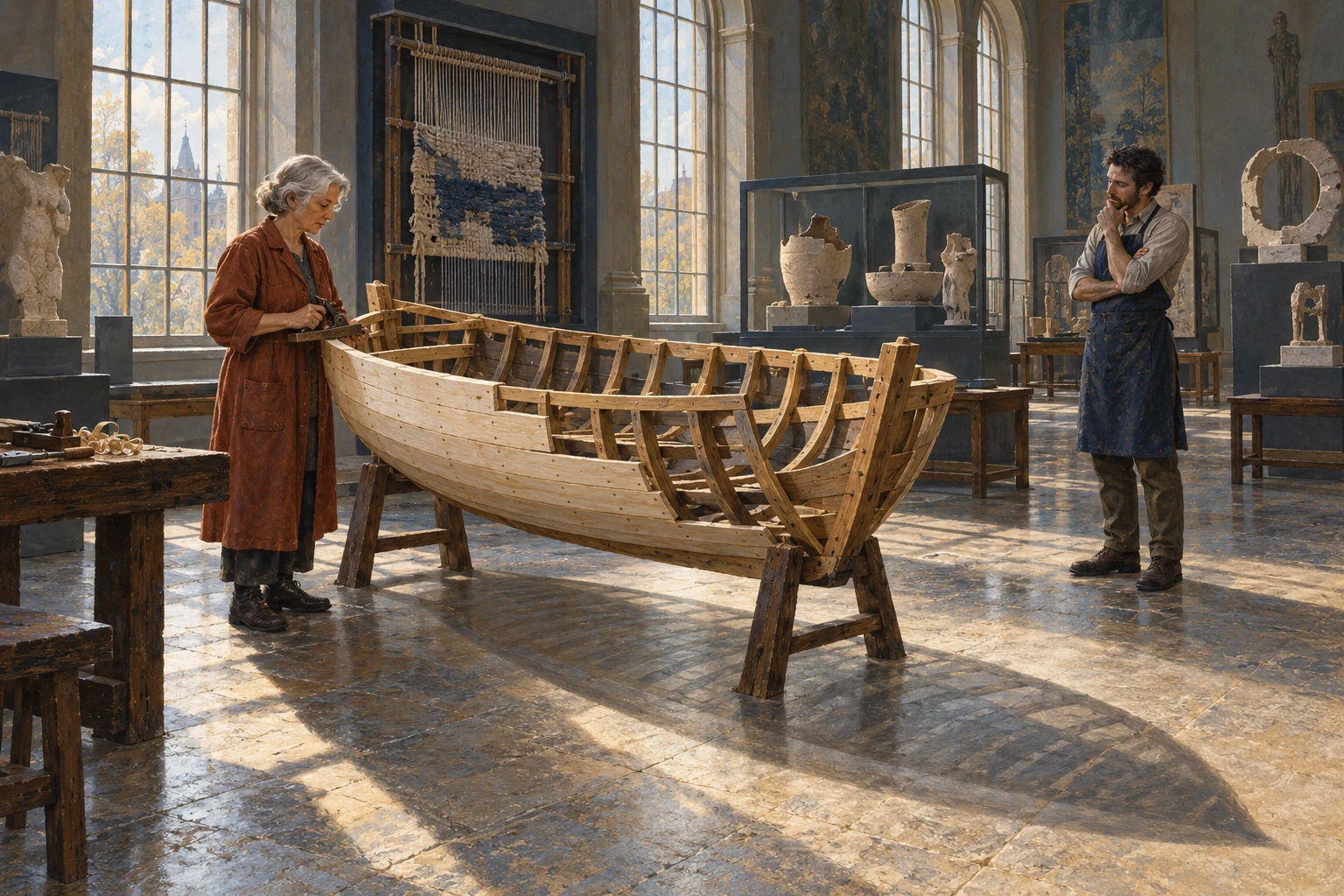
The boat’s shadow had acquired oars since Hema’s last visit.
She crouched beside the trestles. The boat itself still lacked its final six planks, but on the museum floor a complete hull rested in a patch of morning sun. Two slender oars lay across its seats.
“That happens,” the attendant said. “Long residence. The shadows get ambitious.”
Hema stood carefully. “It shouldn’t have a second seat.”
“You can mention it on the condition report.”
She had brought her own plane, wrapped in a tea towel. For twenty-six years the museum had kept the timber exactly as she had left it: no splitting, no beetles, no damp. Even the pencil line where she intended to trim the bow remained sharp.
Outside, her workshop had become a kitchen showroom. Her knees had become unreliable. Arun, for whom she had started the boat, had become a man who sent messages asking whether she had eaten lunch.
He arrived carrying a measuring tape.
“You’re early,” she said.
“You said ten.”
“I meant around ten.”
He waited while she unwrapped the plane. He had his work apron on under his coat. She liked that he still wore one, although she had never understood his preference for furniture that would spend its life indoors.
“I’ve booked the loading door,” he said.
Hema laid the plane on the gunwale. “I thought we were discussing it.”
“We discussed it in March.”
“You asked in March.”
Beyond them stood an unfinished tapestry showing a horse with three legs. Its shadow cantered silently along the skirting board. Hema watched it complete another circuit.
Arun extended the tape along a loose plank.
“The reading room needs two low benches. This would do the seats.”
“That’s cedar.”
“I know.”
“Selected for a hull.”
He retracted the tape slowly, holding the metal so it wouldn’t snap.
The museum had accepted the boat when Arun was twelve. Hema had needed more room for paying work; the curator had offered storage without decay. She would finish it after the winter orders. Then Arun had exams. Then he moved away. Each year she renewed the deposit and wrote the same completion estimate: next spring.
“We could still take it out,” she said. “Once. On the reservoir.”
“Mum, I don’t want a boat.”
He said it without anger. She wished he had been angry; she knew where to put that.
“You used to draw them.”
“I drew excavators too.”
She picked up the plane and ran her thumb along its smooth handle. When he was little, she had let him push while she guided. He always claimed the longest shaving.
“If you take the timber out,” the attendant said from her desk, “the preservation ends. I have to tell you that.”
Hema nodded. Everyone knew the rule. Once work left the museum, time could get at it again.
“And if we change our minds?” Arun asked.
“A finished object cannot be readmitted. Nor can something deliberately taken apart. We preserve interrupted work.”
There was no urgency in her voice. She had a half-eaten pear beside the accession book and seemed perfectly willing to wait.
Hema looked at the boat’s completed shadow. It was handsome. Whoever sat in its second seat would have to keep their knees tucked in.
“You won’t fit,” she said.
Arun glanced at the ribs. “No.”
She had known that before he arrived. She had brought the plane anyway.
∗ ∗ ∗
They sat on the gallery bench to work out what could be salvaged.
Arun’s first sketch used almost everything. Hema crossed out the curved ribs. Straightening them would waste half the morning and leave weak points. He argued for keeping the stern as a bench end. She told him it would catch children’s sleeves. He turned the page and started again.
On the third drawing she found nothing to cross out.
“I want the bow,” she said.
“What for?”
“I haven’t decided.”
He looked as though he might object, then marked it KEEP.
At the desk Hema signed the withdrawal form. In the space for completion estimate, the attendant drew a line. There was no ceremony. She finished her pear while Arun fetched the trolley.
The first screw resisted. Hema insisted on trying it herself, slipped, and cut a pale groove across the brass head.
“Other screwdriver,” she said.
Arun handed it over without offering to take her place.
When the plank came free, one of the shadow’s oars disappeared. By noon there was no boat on the floor, only the ordinary shadows of stacked wood. Hema kept looking at the space between the trestles.
∗ ∗ ∗
The reading room smelled of floor polish. Arun set the first bench beneath a window and knelt to adjust a foot. Hema held the other end steady.
A girl waiting with a book asked whether she could sit down.
“In a minute,” Hema said.
Arun checked the bench, then checked it again. Hema recognized the delay. She took the level from him and put it in the toolbox.
“Go on.”
The girl climbed up, dragging a buckle across the cedar. Hema drew breath. A small white scratch remained beside the girl’s knee.
Arun looked at his mother.
She closed the toolbox. They had a second bench to carry in.