The projector gave its first warning at 1:27, three minutes before Anika’s final show. It was a dry click behind the lamp housing, too small for anyone in the waiting room to hear over the rustle of paper costumes.
The cooling fan sounded as it always had. Beyond the booth window, eighteen seats faced a dome lit by a machine whose makers had punched thousands of holes into metal.
The college was closing the planetarium after forty-one years. Its roof leaked; its electrical system needed replacing. Next week the projector would be dismantled. Tonight’s Halloween program had sold out. One-thirty was supposed to be the last performance.
“You look like someone about to sit an exam,” said Milo, the student taking tickets. He picked up a cardboard astronaut abandoned beneath a chair. One silver arm had fallen off.
“Check the back latch,” Anika told him. “It catches.”
∗ ∗ ∗
The audience came in wearing the remains of the evening: green face paint, plastic fangs, a pair of orange wings folded into a handbag. Anika dimmed the aisle lamps. The old motor rose to its working pitch.
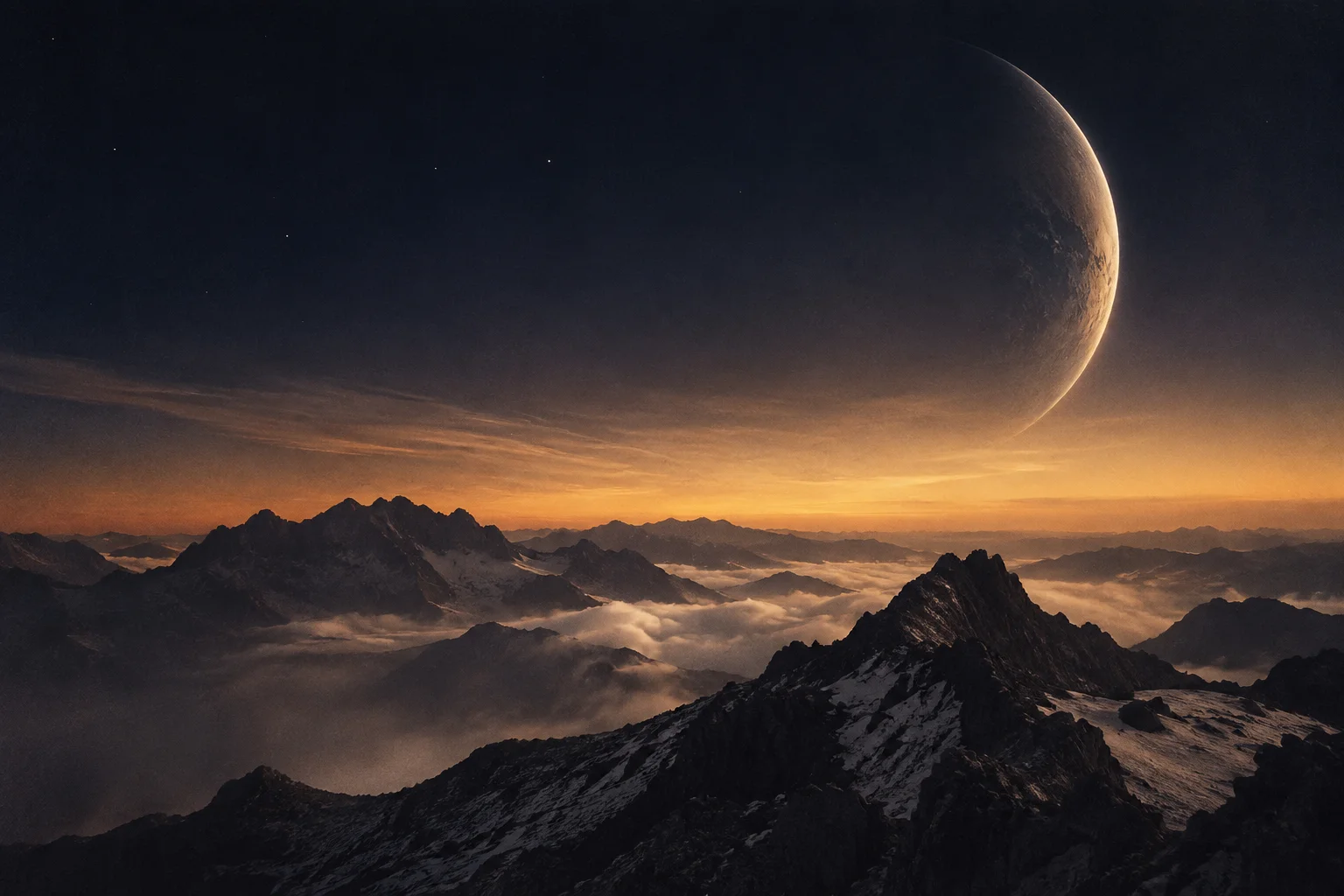
First came the sky above their town. Then a planet appeared over mountains beneath an enormous crescent moon, a landscape the art students had invented for a lesson about possible worlds. A boy in the front row reached upward, as if the crescent had a cold surface he could touch.
Anika had given versions of this talk for eleven years. She knew where children gasped and when adults stopped whispering. She had prepared a farewell sentence about light crossing enormous distances. When she reached it, she hurried.
The boy asked if anyone lived on the painted planet.
“We don’t know,” she said. “This particular place came from somebody’s drawing.”
At 1:54 she brought back the familiar stars. The audience applauded. Anika slowed the motor and turned off the lamp. A click came again, followed by the smell of overheated dust. An amber fault light appeared. The technician’s warning was clear: do not restart a lamp with that fault. There was no replacement on site.
Milo was collecting the cardboard astronaut when the ticket printer began to chatter.
∗ ∗ ∗
When the counter clock reached 2:00, it returned to 1:00. Anika expected that; the clocks were turning back tonight. She did not expect a second queue.
Nine people stood under the awning, holding valid tickets marked 1:30 A.M. The booking numbers differed from those of the earlier audience. The reservation system had sold seats for both occurrences of one-thirty. Nobody had noticed that it was selling two final shows.
“We came for the second one,” said a woman in an airport-laundry uniform, her hair still damp at the temples. “My shift finished at one-ten. I checked.”
Anika checked too. The bookings were real. So was the fault light.
“The projector has failed,” she told them. “I’ll refund your tickets. I’m sorry I can’t give you the show.”
A man holding a sleeping child asked when the next performance would be. When Anika explained there would be none, he looked past her at the doors. “We drove an hour,” he said. “She wanted to see the mountains.” He carried the child back to his car.
Two other visitors left. The laundry worker stayed, along with an older couple and a girl clutching a folded star chart.
“I can show you the machine,” Anika offered. “It’s safe to view now. That won’t replace what you bought. You’ll still have your refunds.”
“I’d prefer the tour to nothing,” the older man said. His companion said she would have preferred the performance. They went in together.
∗ ∗ ∗
Anika switched on the work lights and opened the booth curtain. The projector, magnificent when it filled a ceiling, looked awkward at rest: a dark metal sphere, squat supports, bolts marked by several generations of paint. Tiny openings sent light to the dome; separate lenses carried the brighter planets.
The girl held up her chart. “Is this where Orion goes?” Anika found the three holes of the belt. The rest was harder to recognize. Metal offered no drawing of the hunter, only places where light could pass.
“I thought it was a video,” the woman from the airport said. “That’s a lot of holes.” She asked how anyone cleaned the lenses. Anika described the two-person job of reaching the ones high inside. The woman listened like someone who knew what happened when delicate equipment was cleaned in a hurry.
They asked questions Anika had never been given time to answer. Had anyone punched a hole in the wrong place? Yes; a replacement plate had been made in the nineties. Was the painted crescent moon one of those holes? No. It came from a slide; the artist’s first version had two moons, until an astronomer asked her to choose.
Near the end, the girl asked, “If you’d known there were two shows, would you have saved the good lamp for us?”
“I’d have tried to keep it running for both,” Anika said. “I don’t know if it would have lasted.”
“So the others got lucky.”
“Yes.”
The girl had bought a sky and received a broken lamp and an explanation. Anika could not make the explanation equal to the sky.
At 1:56, for the second time, Milo opened the doors. The airport worker took her refund and said she was glad to have seen inside. The older couple disagreed about whether to tell their grandchildren they’d attended the last show. The girl folded her chart and asked where she could learn to repair a projector.
Anika told her about the optics workshop across the courtyard. It would open on Monday, even after the planetarium closed. She wrote the room number on the girl’s ticket and watched her hurry after the others.
At two o’clock, this time without a reset, Anika went into the empty dome to retrieve a silver cardboard arm from beneath a seat. Milo fastened it to the lost astronaut with a strip of tape and stood the little figure upright on the counter for whoever came looking.