The first item on the inventory was a green plastic colander. Mara wrote it down because her brother insisted they were making a complete list. Their mother had lived in the same apartment for thirty-seven years, and the landlord wanted the rooms empty by Friday. They had four days, two cars, and a notebook with a broken spiral.
Her brother, Dev, had brought colored stickers. Red meant donate, blue meant keep, yellow meant decide later. By noon nearly everything wore yellow. Mara suggested that a system unable to produce decisions was not much of a system. Dev said at least it prevented arguments. They argued about the colander for six minutes.
The apartment had no great secret. Their mother had been a school secretary, fond of crossword puzzles and practical shoes. She had died in August after a short illness. The furniture was ordinary and the drawers contained what drawers usually contain: batteries of uncertain age, buttons without shirts, envelopes that had once seemed worth saving.
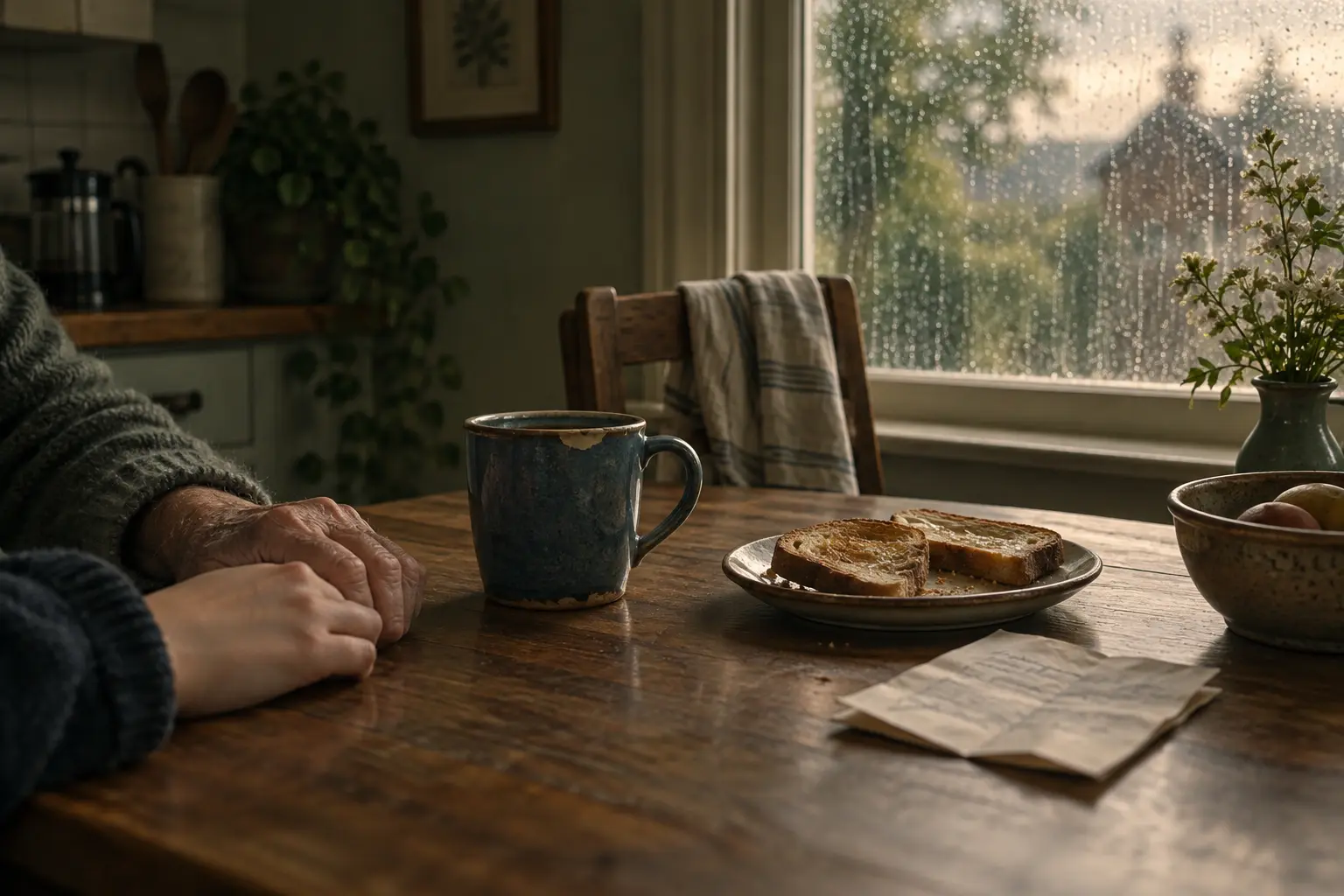
At the bottom of a kitchen cabinet, Mara found a biscuit tin filled with small squares of paper. On each was a date and a sentence in their mother's careful handwriting. June 14: Dev made breakfast without being asked. September 3: Mara called from the bus just to tell me about the sky. December 22: We ate oranges because the electricity went out.
Dev read the slips slowly. There were hundreds. Some recorded holidays, but most marked things neither sibling remembered. A neighbor returning a borrowed ladder. A burnt saucepan. A man at the market who had offered their mother his place in line. Their mother's life, Mara realized, had apparently consisted of an enormous number of Tuesdays.
“We should scan them,” Dev said. He took out his phone and photographed the first three. Mara asked whether he planned to photograph every scrap. “Why wouldn't I?” he said. “She thought they mattered.”
What an inventory cannot decide
Mara wasn't sure that followed. Their mother had also kept grocery receipts until the ink vanished. She had saved elastic bands that snapped when stretched. Keeping something might mean it mattered. It might also mean there had been a convenient tin.
That afternoon they carried boxes down three flights of stairs. The building's elevator had been broken since spring. On the second trip Dev stopped at the landing to catch his breath and told Mara that he had been visiting their mother every Sunday for the last two years. Mara knew he visited, but not how regularly. She lived farther away and called most weeks. She felt an old, unreasonable wish to turn the conversation into an accounting exercise.
“You could have told me,” she said. “I wasn't keeping score,” he answered. His voice suggested he knew that she was.
Back upstairs, she searched the tin for a note about Sundays. There was one from February: Dev came over. We watched the weather report twice. She found another from May: Mara sent a photograph of a dog wearing boots. Then a slip with no date: Children have their own lives. I like hearing about them.
Mara sat on the kitchen floor with that last piece of paper. She could not tell whether it was reassurance, a complaint, or a reminder their mother had written for herself. She wanted it to settle something between her and Dev. Instead it refused to become evidence.
By evening they had filled seven donation bags and kept two boxes. The tin sat apart from both piles. Dev proposed dividing its contents by year. Mara suggested leaving it intact. “Then neither of us gets to read it,” he said. “We can read it here,” she replied. “We don't have to own every part of her.”
The things she noticed
Dev looked around the stripped kitchen. “Friday we won't have a here.” It was the first thing either of them had said that day without trying to solve it.
On Thursday, their last full day, they invited the downstairs neighbor up for tea. Mrs. Rao had known their mother for twenty years and remembered things the siblings didn't: the winter she helped organize a tenants' petition, the time she learned to repair a leaking tap from a library book, the way she always checked whether the mail carrier had eaten lunch. None of those events appeared in the tin. Their mother had not recorded everything. She had recorded what she happened to notice.
Mrs. Rao recognized the biscuit tin. “She used to read me one when I came upstairs,” she said. “Sometimes she'd laugh before she finished.” Mara asked if the notes had been intended for the children. Mrs. Rao shook her head. “She never said. I think she liked having a reason to notice the day.”
Friday morning, Dev brought a small cardboard box with a lid. They placed the tin inside and agreed to keep it together for now, taking turns storing it. Mara copied one note onto a piece of plain paper, the one about the oranges and the power cut. She remembered the cold kitchen and their mother peeling fruit by flashlight. Dev remembered being furious that his game console had shut off. Both memories fit.
At the door, Mara noticed the green colander on the counter. Its sticker was still yellow. She put it in the donation bag. Dev started to object, then stopped. Neither of them had used it in years, and no inventory could make the kitchen remain.
Outside, the landlord locked the apartment. Mara held the cardboard box while Dev searched for his car keys. The tin was heavier than she expected. She wondered how many ordinary days a person could carry before the weight became impossible, then decided the question had no useful answer. Dev found his keys. They went down the stairs together.
Part of Beyond the Known, an independent journal by Arin Vale.
Related reading: What Does a Recipe Remember? — on what objects carry and what they cannot
Read our editorial approach