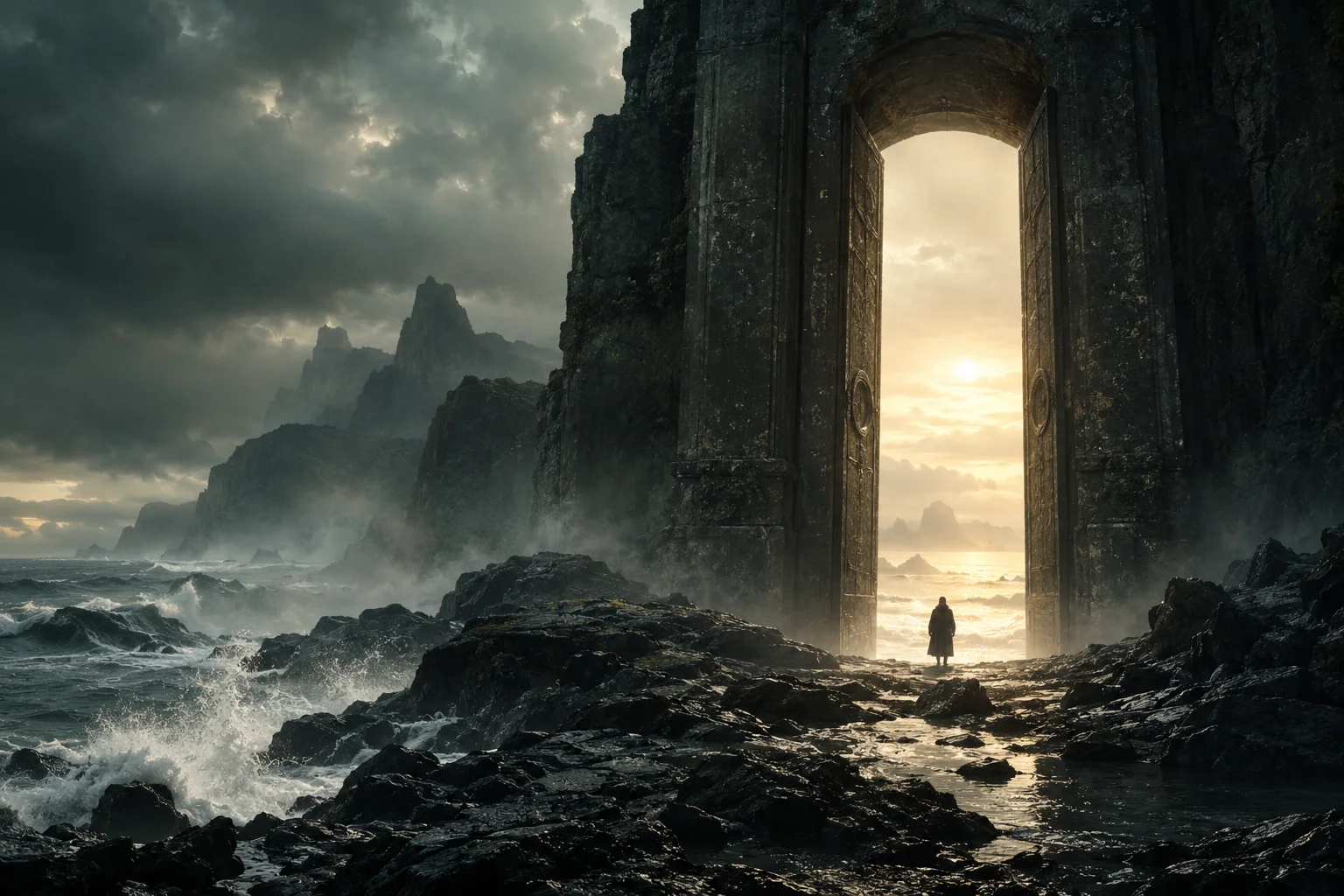
The moon came on at nine, four minutes late, and the crowd booed as if it were a singer who had forgotten the words.
From the maintenance balcony, Mara could see the artificial disk climbing over the harbor. Six hundred mirrored panels, suspended from a tethered platform, caught sunlight redirected from orbital collectors. From the waterfront it looked almost convincing. From her balcony she could see the seams and the small black patch where panel 118 had stopped turning.
The city had installed the moon after the real one became difficult to see through the permanent high-altitude haze. Hotels sold moon-view rooms. Restaurants served dinner beneath it. Mara worked nights calibrating the panels, which was how she knew that the moon never rose for anyone who lived beyond the waterfront.
On Thursday a boy named Teo appeared at the service entrance carrying a cardboard telescope. He was twelve, possibly thirteen, and had an appointment slip with a municipal stamp. Mara had not seen an appointment on her calendar.
‘I won the school astronomy prize,’ he said. ‘A visit to the moon controls.’
‘You won a tour of the lighting equipment.’
‘Same thing on the certificate.’
She let him through. He asked good questions, which made the tour longer than it was supposed to be. Why did the disk have phases? Because the control software changed the angle of the panels. Why did it disappear at midnight? Because the hotels paid for four hours and the platform needed cooling time. Why didn't they make stars?
‘We tried,’ Mara said. ‘People complained they looked fake.’
Teo unfolded his telescope on the balcony. He pointed it away from the shining disk, toward a patch of sky above the old shipyard. Then he asked whether she could switch the moon off for ten minutes.
‘No.’
‘Five?’
‘What are you looking for?’
‘The comet.’ He showed her a printout from an amateur astronomy club. A small comet would pass low over the eastern horizon shortly before ten. It would be faint, perhaps invisible through the haze, but the club had marked tonight as their best chance. The artificial moon was spilling enough light over the water to erase the dimmest objects.
‘You could go outside the city,’ Mara said.
‘My grandfather can't travel. He used to teach astronomy. He says a comet isn't special because it's bright. It's special because it doesn't belong to anybody.’
Mara checked the control board. A temporary blackout required two authorizations: hers and the duty supervisor's. The city also had a rule against unannounced interruptions to contracted lighting. Tonight the harbor restaurants were full, and a wedding was taking place on a terrace below. The moon was part of somebody's photographs, somebody's proposal, somebody's carefully timed evening.
‘The city paid for the platform,’ Teo said.
‘The restaurants help pay to keep it running.’
‘So who owns the sky?’
She disliked the question. Not because it was foolish, but because it turned a maintenance shift into a debate she had not agreed to have.
She called her supervisor, Lian, who was eating noodles at the far end of the control room. Lian listened, examined the astronomical printout, and said the comet probably wouldn't be visible anyway. The haze was worse than last year.
‘Then the interruption buys us nothing,’ Mara said.
‘Or it buys a chance,’ Teo replied.
Lian looked through the balcony window at the wedding guests arranging themselves under the silver disk. ‘If we shut it down, they'll complain. If we don't, nobody even knows what they've missed.’
‘I know,’ Teo said.
Mara could not switch off the moon simply because one visitor asked. She could, however, use the public service channel. It had been installed for maintenance notices and was almost never used. She typed a message proposing a seven-minute dimming at 9:48, with the reason, the uncertainty, and the names of the people authorized to approve it. The message would go to the waterfront venues and the neighborhood screens. Venues could object before 9:40.
The first objection arrived in eleven seconds. A hotel manager cited the promise made to guests. A restaurant owner said the interruption would spoil a birthday dinner. A wedding planner wrote in capital letters that the couple had chosen the date for the moon.
Then came other replies. The night-shift nurses at the hospital asked which direction to look. A ferry captain offered to dim his deck lights. Someone at the public library said they would wheel the old telescope onto the roof. A woman asked whether the real moon was still there.
At 9:39 the wedding planner called. Mara expected shouting. Instead the planner asked if the seven minutes could begin at 9:52, after the couple's first dance. Mara checked the comet's predicted position. Four minutes mattered, but not decisively. She asked Teo.
‘We might miss it,’ he said.
‘We might miss it at 9:48 too.’
Teo folded the printout along its creases. ‘Then tell them 9:48. Don't pretend it doesn't cost anything.’
Lian signed the authorization. Mara signed beneath her. At 9:48 she turned the panels away from the collectors. The artificial moon did not go out at once. It faded in sections, like a theater audience standing to leave.
Below them the waterfront became darker, though never truly dark. The restaurants kept their lamps. The harbor kept its navigation lights. Someone cheered. Someone else shouted an insult that reached the balcony a moment later.
Teo adjusted the telescope. Mara looked through it first, seeing only a faint gray smear where the haze thickened. She gave the eyepiece back to him. For a long minute he said nothing. Then he moved aside so Lian could look.
‘Is that it?’ Lian asked.
‘I don't know,’ Teo said. ‘It could be a cloud edge.’
At 9:55 the panels began to turn again. The disk reassembled itself over the water. From the wedding terrace came applause, though Mara couldn't tell whether it was for the lights or for the couple.
The next morning, the city received twenty-three complaints and eighty-one requests for another dark interval. The astronomy club posted a photograph showing a tiny pale streak, but its caption said only POSSIBLE COMET. Mara printed it for the control room. Teo sent a second photograph, taken through the cardboard telescope: his grandfather at the window, one hand resting on the sill, looking toward the part of the sky that had been allowed to be uncertain.
On the next week's schedule, between panel inspection and cooling cycle, Mara added a line: PUBLIC DARKNESS REQUESTS — REVIEW FRIDAYS. She left the time blank.