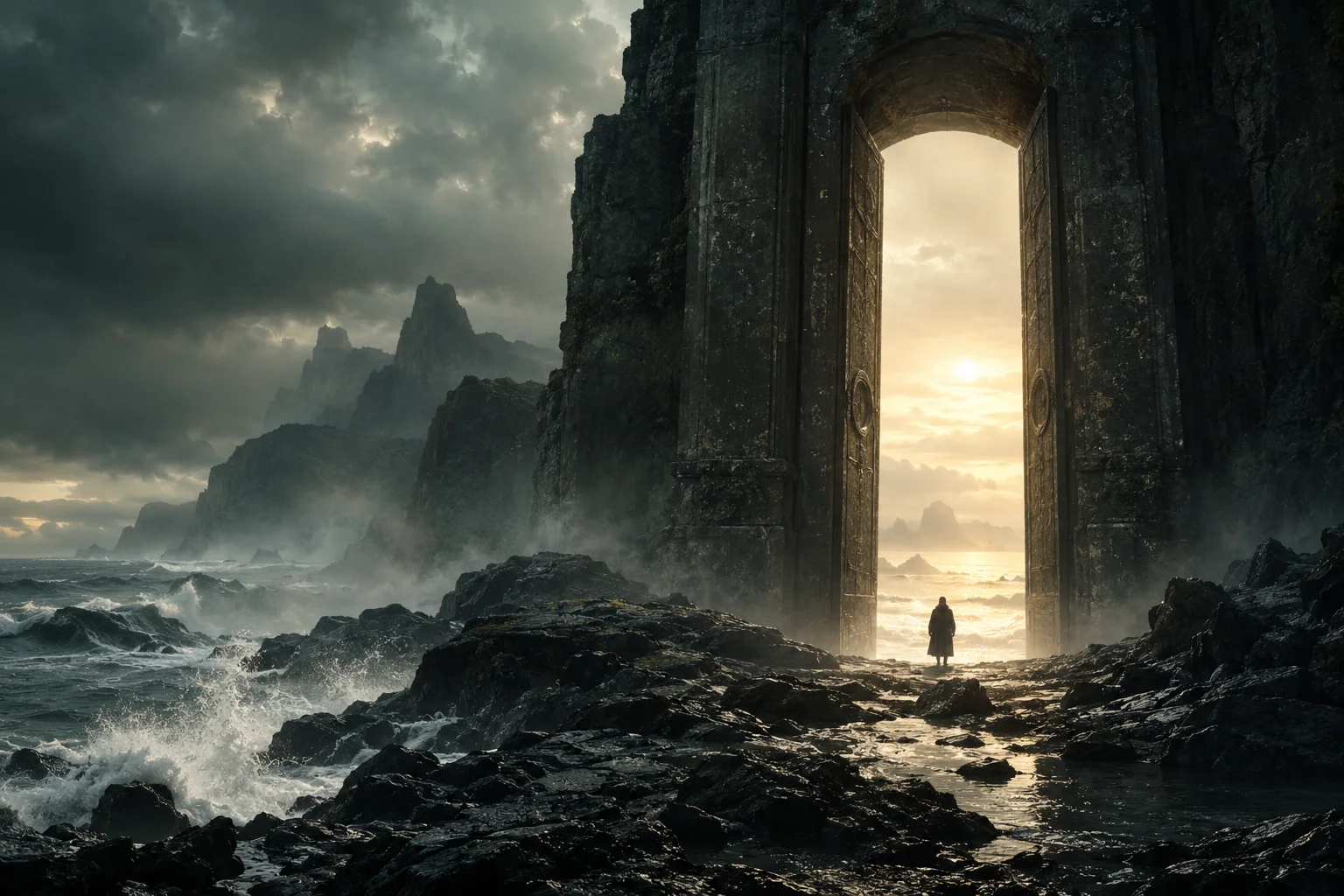
By the time Ina reached the north shelf, the warning had been photographed from three angles. Someone had arranged pale stones to spell NO across the black shingle. In the clearest photograph, the rising tide was about to swallow the N.
The harbor council had hired Ina to survey the shelf before her father's dredger cut a deeper passage. The winter cargo ships drew too much water for the old channel. Without the cut, fuel cells and flour would arrive in smaller loads, at a price the island could scarcely afford.
The photograph was suspiciously readable. Every stone was the same size; the gap between the letters was just wide enough for the camera on the survey drone. Ina recognized the careful spacing from her brother's school notebooks.
Pel was sixteen, with scraped knuckles and an infuriating talent for appearing innocent.
She found him behind the workshop, rinsing white chalk from a sack. He looked at her boots before he looked at her face.
“They really do move stones,” he said. “You told me that yourself.”
“Not into letters.”
“Nobody came to look when they were just making piles.”
The shellwrights occupied a chain of tide pools below the breakwater. They were small, blue-shelled animals bred years earlier to hold loose banks together after storms. Their original research grant had ended; the shellwrights had not. They had spread into the harbor, building low crescents of pebbles around their translucent egg clusters.
On the engineering drawing, their shelf was labeled VACANT FILL.
“You can't submit that picture,” Ina told him.
“Then submit the real ones.” Pel showed her a dozen photographs of wet stones. Without the movement, they could have been pictures of any beach. “Tell me which one anyone will open.”
She had no good answer. The dredging contract employed seven people, including their father, and the old channel was not getting any deeper by itself. Pel knew both facts. He had made the sign anyway.
At supper their father put a stack of invoices between the salt and the bread. The engine overhaul had been paid for on credit. The harbor job would clear most of it.
“Do your survey,” he told Ina. “If there's something there, write it down. But don't ask me to put my crew ashore because your brother has discovered lettering.”
Before dawn she set a camera on a fixed tripod, laid three red pebbles beside an active nest, and mapped the pool's current with strips of thread. Pel stayed on the breakwater. She did not allow him near the water.
For twenty minutes nothing happened. Then one shellwright emerged, hooked a pebble beneath two jointed limbs, and pushed it against the current. Another brought a smaller stone. Together they lengthened the wall on the side where the water struck hardest.
A wave tipped the red pebbles into the pool. The animals ignored their color. They gathered whichever stones fit the gap, moving one of Ina's markers and leaving the other two.
The behavior was not a conversation. It was construction, repeated at three nests over two low tides, with the animals adjusting their walls when the water changed direction.
Ina sent the footage, raw and uncut, to the harbor engineer. She included Pel's staged photograph under a separate heading: HUMAN INTERFERENCE. Her brother refused to speak to her for the rest of the day.
The engineer called that evening. “You have evidence of nesting activity. You do not have evidence that these things are intelligent, or that they can't be moved. They were engineered to build banks. That's what they're doing.”
“I didn't say they were intelligent,” Ina replied. “I said we're about to dredge the bank they're building.”
He reminded her that the cargo company had already diverted one ship. Another delay would mean a surcharge, and the island's fuel store was low. No one in the meeting tomorrow would have the luxury of considering only the animals.
She spent the night drawing alternatives. Cutting farther east would destroy a strip of planted eelgrass. Leaving the shelf intact meant reducing the depth of the channel; the largest ships would have to unload part of their cargo at the outer pier and transfer it by barge.
The figures were ugly. The barge transfer cost money, took longer in rough weather, and would reduce the dredging company's fee. When Ina showed her father, he ran a finger down the estimate and named the crew members who might lose hours.
“I know them,” she said.
“That's why I want you to remember they're in this drawing too.”
At the council meeting, Pel's photograph appeared on the wall before Ina's footage. Someone in the back laughed at the enormous NO. Ina stood up and said exactly who had arranged the stones. She could feel her brother shrinking beside her.
Then she played the uncut recording. The shellwrights worked without looking up. Nobody could mistake the little blue bodies for letters, and nobody could honestly call the shelf empty afterward.
The vote was four to three. The council chose the shallower channel for one season, with the outer-pier transfer paid for from the harbor maintenance reserve. They would review the depth after winter. It was a costly delay, not a permanent sanctuary.
Her father took the revised contract home without opening it. Two crew members would lose a week's work. At the workshop Pel tried to thank her, then stopped when he saw their father at the table with the invoices.
“You were right that they needed looking at,” Ina told Pel. “You made the first thing everyone saw a lie.”
“And if I hadn't?” he asked.
She could not tell him the truth would have been enough. The council had needed photographs, measurements, and a budget that made the choice possible. They had almost voted against it even then.
On the first day of dredging, Ina stood beside the new red boundary stakes. The bucket lifted a load of mud from the approved channel. Her father's crew worked carefully, though the engine ran longer than it would have on the original route.
At low tide a shellwright climbed out of its protected pool carrying a pebble. It crossed the red line and placed the stone at the edge of the fresh cut, where the current was strongest. Two others followed it. Ina opened her field book to a clean page and began another survey.