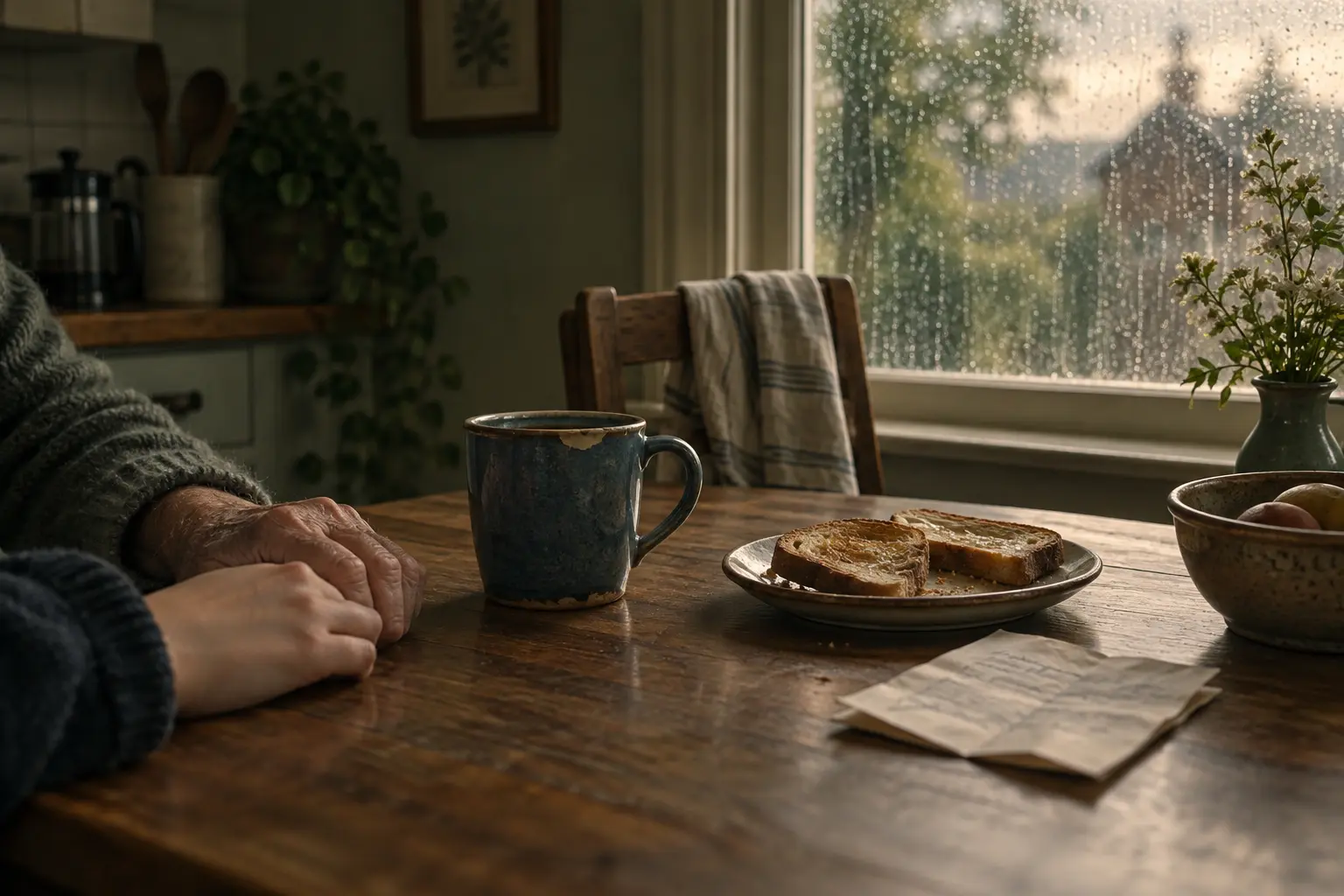
On Tuesday morning, the kitchen repeated Jonas twice.
The first voice came from the ceiling speakers, warm and level: “I wish we did not wait until something breaks to talk about it.”
Half a second later came Jonas himself, standing beside the sink with a wet dishcloth in one hand.
“You never listen until something breaks.”
Tess looked up from the table.
Jonas looked up too.
The courtesy light above the pantry blinked amber, then went dark.
Neither of them spoke.
They had installed the mediator twelve years earlier, when the house was new to them and every disagreement seemed to arrive with an audience. It was a small wooden receiver built into the kitchen wall, old-fashioned on purpose. When voices rose past a threshold, directional speakers and cancellation panels softened the words before they crossed the room. The company called it conversational support. Tess and Jonas called it the box.
The box was not supposed to invent a different argument. It was supposed to remove heat without changing meaning.
Tess pointed at it. “Did it just rewrite you?”
Jonas put down the dishcloth. “Apparently badly.”
“No. I mean before.”
He understood what she meant.
For years, one of them would say something sharp and the other would hear something calmer. They knew this in the abstract. They had agreed to it. But the system usually left no seam between the sentence spoken and the sentence received.
Now the seam was sitting at the breakfast table with them.
∗ ∗ ∗
The repair manual was still in the drawer with takeaway menus from restaurants that no longer existed.
Tess opened the receiver while Jonas made tea. Inside were dust, two ceramic boards, a cooling fan and a row of status lights so small she needed her glasses to read them.
“Do you remember choosing adaptive smoothing?” she asked.
“I remember choosing de-escalation.”
“This says adaptive.”
He leaned over her shoulder. “Maybe that was the update.”
The service history showed seven major updates. The third had added interruption control. The fifth had added intent preservation. The sixth had changed the default from literal-first to outcome-first.
Tess read the line again.
OUTCOME-FIRST MEDIATION: PRIORITIZES CONSTRUCTIVE INTERPRETATION WHEN LITERAL PHRASING MAY ESCALATE CONFLICT.
“Constructive according to who?”
Jonas took his cup to the window. Rain had turned the garden path the color of old coins.
“According to the people who did not want couples shouting at breakfast, I suppose.”
“We were not shouting.”
“We used to.”
That was true.
They had once been very good at finding the exact sentence that would keep an argument alive. The box had helped. It gave them a fraction of a second in which the cruelest version of a thought could arrive with its teeth filed down.
There had been evenings when that was a mercy.
Tess hated that this was also true.
∗ ∗ ∗
The technician arrived after lunch. She was younger than the receiver.
“First-generation home mediator,” she said, almost affectionately. “You do not see many still running.”
She connected a diagnostic strip. The unit had a failing delay module, which explained the double playback. The semantic system itself was working exactly as designed.
Tess asked how often it changed their words.
“It does not store speech,” the technician said. “Only intervention counts.”
She turned the screen around.
Last thirty days: forty-three interventions.
Tess laughed once. “Forty-three?”
Jonas folded his arms. “We have been discussing the roof.”
“Apparently very constructively.”
The technician smiled, then stopped when neither of them did.
Newer units, she explained, offered three modes. Literal preserved every word and only reduced volume. Assisted could rephrase, but both people heard a soft tone when it did. Outcome-first worked like their current system: invisible unless something went wrong.
“Which one do most people use?” Jonas asked.
“Outcome-first.”
“Does it work?”
The technician considered this longer than Tess expected.
“People report fewer arguments.”
“That was not the question,” Tess said.
The technician closed her case halfway. “It is the answer I have.”
∗ ∗ ∗
They left the mediator off that evening.
At first the silence felt theatrical, as if both were waiting for the other to perform authenticity.
Jonas cooked. Tess dried the repaired leak beneath the pantry. He put a pan in the wrong cupboard.
“That does not go there,” she said.
“It has gone there for six months.”
“Because you keep putting it there.”
He opened his mouth, stopped, and tried again.
“I know you hate that cupboard. I keep forgetting.”
Nothing glowed amber. No ceiling voice improved him.
Tess noticed the small pause before the second sentence. She had heard pauses like it for years and assumed they belonged to the machine.
“Thank you,” she said.
Later, the roof came up again.
Jonas wanted to replace the western section before winter. Tess wanted another estimate. They did not become wiser because the box was silent. Ten minutes in, Jonas said she was treating every decision like a cross-examination.
The words landed intact.
Tess felt herself reach for the answer that would hurt.
She did not say it.
That restraint felt different when nobody else could take credit for it.
“I am still angry with you,” she said.
“I know.”
“And I do not want the house making me sound less angry than I am.”
Jonas nodded. “I do not want it making me kinder than I am.”
They sat with that for a moment.
Then Tess said, “I would still prefer you to be kinder than you are.”
“Reasonable.”
∗ ∗ ∗
The technician returned the next morning with the replacement module.
“Mode?” she asked.
Tess looked at Jonas.
He said, “Assisted.”
She shook her head.
For a second he looked disappointed.
“Literal,” Tess said. “But keep the warning light.”
The technician selected the setting.
The mediator restarted with a quiet click. The amber light came on once, then settled to blue.
It would still tell them when the room was getting loud. It would not tell them what they meant.
Jonas left the pantry door open on his way out.
Tess stared at it.
“Close the damn door.”
The light flickered amber.
The sentence stayed exactly where she put it.